Developed in 2025-2026
CARE-CENTERED
DESIGN
FRAMEWORK
// Design Research
// Care Infrastructure
// Spatial Theory
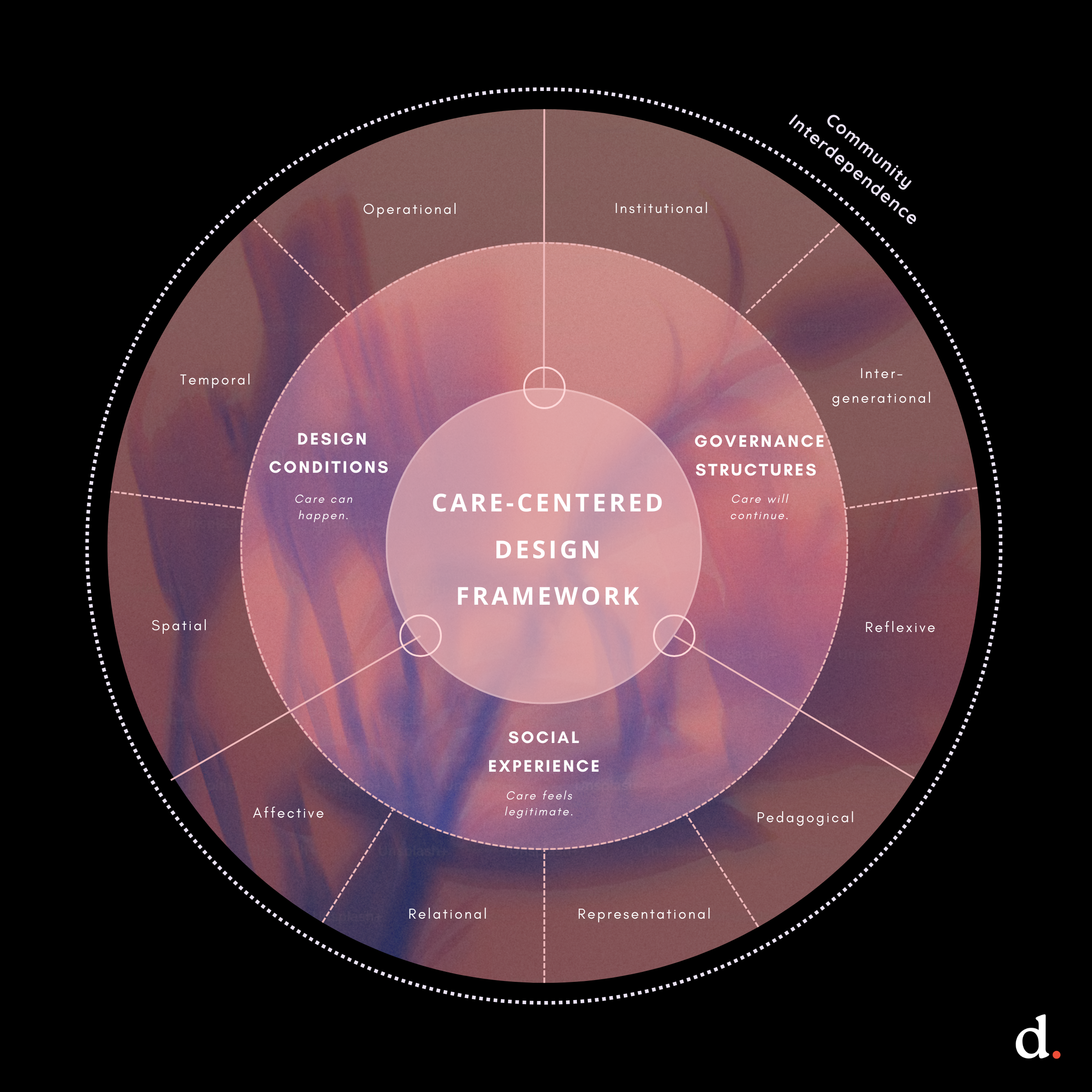
The Care-Centered Design Framework provides a multi-scalar analytical lens for evaluating and designing care infrastructure in public and community spaces. Drawing on feminist infrastructure studies, design justice, and commons governance scholarship, it addresses how institutions claim to serve communities while systematically excluding intergenerational care.
The framework examines three interdependent layers:
DESIGN CONDITIONS → Care can happen → Spatial, temporal, and operational infrastructure determining whether care can physically occur. Dimensions include physical layout and accessibility; temporal rhythms and flexibility; policies, staffing, and economic access.
SOCIAL EXPERIENCE → Care feels legitimate → Affective atmosphere, relational dynamics, representational visibility, and pedagogical design assessing whether care is culturally valued. Examines sensory environment, staff and peer interactions, visibility of diverse families, and intergenerational learning opportunities.
GOVERNANCE STRUCTURES → Care will be sustained → Institutional decision-making, intergenerational reciprocity, and reflexive capacity determining sustainability without commodification or precarious volunteerism. Analyzes resources and accountability, support across life stages, and organizational learning.
All three layers rest on Community Interdependence: the peer-to-peer relationships and mutual aid networks enabling care-centered design.
The framework's visual language intentionally employs aesthetic codes associated with care and embodiment. The organic forms and pink palette challenge the devaluation of feminized labor in infrastructure design, asserting that care work merits serious attention without adopting masculine-coded aesthetics for legitimacy.
Applied initially to cultural institutions—museums, libraries, community centers—the framework guides participatory design with caregivers, architects, and community organizations building care-centered spaces.
Credit: Background image by Evelyn Verdín via Unsplash.